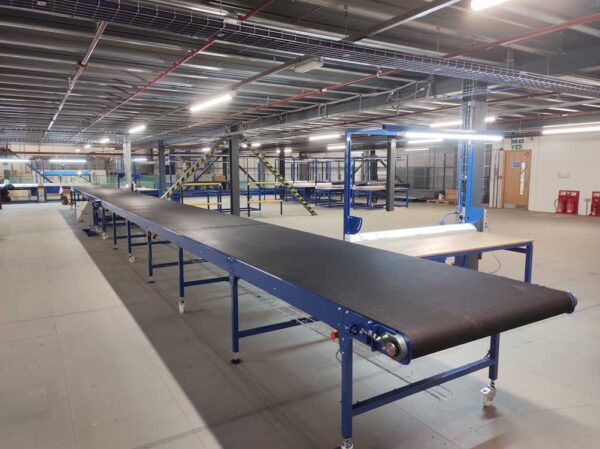
Agravity conveyor system uses natural force or manual pushing by a person to move products without a motor or electricity, making it one of the most cost-effective material handling solutions available. However, knowing when NOT to use gravity conveyors is just as important as understanding their benefits. Let’s examine how these non-powered systems work, where they excel, and situations where choosing a gravity conveyor could harm your operations.
Understanding Gravity Conveyor Systems: The Basics
A gravity conveyor system operates by using inclines and manual force to move goods without electrical power. This simplicity offers fewer running costs and minimal maintenance requirements.
The absence of motors, control panels, and electrical components means quick installation and continued operation during power outages. Products move through gravity on slight declines or manual pushing on level sections. This straightforward operation simplifies training and reduces complexity compared to powered alternatives.
We manufacture gravity roller and other specialisedconveyors that exemplify these principles, providing robust solutions for UK businesses needing reliable, cost-effective material handling.
Two Main Types of Gravity Conveyor Systems
Each type of gravity conveyor system serves different applications based on load requirements and product characteristics.
Gravity Roller Conveyors
These systems use cylindrical rollers mounted in sturdy frames to support and move products. The rollers rotate freely on bearings, allowing boxes, totes, and pallets with flat bases to glide smoothly along the conveyor path.
Roller conveyors handle heavier loads and provide better support for larger items. Their robust construction suits demanding industrial environments. Roller spacing adjusts based on product size, ensuring stable support throughout transit.
Skatewheel Conveyors
Skatewheel systems use individual wheels mounted on axles. These lighter-duty conveyors work well for smaller items and excel at navigating curves, as each wheel rotates independently to guide products around bends.
Their flexibility makes them popular for temporary setups and applications requiring frequent reconfiguration, though they’re best suited for lighter loads than roller conveyors.
Where Gravity Conveyor Systems Excel
Gravity conveyors deliver value in specific applications where their simplicity and zero power consumption provide clear operational advantages.
-
Packing and Assembly Lines
Gravity conveyors shine in sequential processes where products move from station to station. Workers complete tasks and push items forward, creating a smooth workflow without an electrical infrastructure. This simplicity reduces the risks of breakdown and protects operations during equipment maintenance.
Packing benches integrated with gravity conveyors create efficient stations where products flow naturally through the packing process.
-
Loading and Unloading Operations
Flexible and telescopic gravity conveyors extend from loading bays into vehicles, speeding up manual loading and reducing worker strain. Adjustable length and height accommodate different vehicle types and loading scenarios.
-
Sorting and Marshalling Areas
Gravity conveyors create low-cost sorting lanes for organising products by destination, order type, or priority. Items easily divert from main lines onto gravity spurs for palletising or dispatch preparation.
-
Connecting Powered Systems
Gravity conveyors are economical bridges between powered sections, maintaining product flow without additional motors and controls. This hybrid approach optimises costs and maintains operational efficiency.
Situations When You Should NOT Use Gravity Conveyors
Understanding when gravity conveyors become liabilities can help protect your operation from inefficiency, product damage, and safety hazards.
1. When Speed Control and Product Accumulation Matter
Gravity conveyors cannot control descent speed, causing acceleration on slopes that damages products or creates safety risks. Products continue moving until colliding with items ahead, creating line pressure that crushes fragile goods.
For controlled accumulation or consistent spacing, powered roller conveyors with zero-pressure accumulation technology provide necessary control, stopping products gently while maintaining separation.
2. When Moving Items Uphill
Gravity works in one direction only: down. Any upward movement eliminates gravity conveyors from consideration.
Incline belt conveyors or powered systems with high-friction surfaces handle elevation changes. Our inclined swan neck conveyors are a reliable solution for moving products between levels.
3. When Handling Items with Uneven or Soft Bottoms
Products without flat, rigid bases may fail to work on gravity conveyors:
- Bags and sacks sag between rollers, creating friction that stops movement
- Items with feet catch on roller gaps, causing jams
- Soft materials deform under weight, increasing resistance
- Small items fall through gaps or turn sideways
Belt conveyors provide continuous surfaces that best support these challenging products.
4. When Precise Positioning Is Required
Automated processes require exact positioning that gravity conveyors fail to provide. Robotic systems, automated labellers, and precision assembly require products to stop at specific locations with millimetre accuracy.
Powered conveyor systems with integrated sensors and controls provide the precision these applications demand.
5. When Moving Items Over Long, Flat Distances
Pushing items along flat gravity conveyors can become inefficient over longer distances. Momentum dissipates, needing repeated pushing that strains workers and slows operations.
Power belt or24V powered roller conveyors improve productivity and worker comfort for level transportation over large distances.
Making the Right Conveyor Choice
Choosing between gravity and powered systems requires analysing the following:
- Product characteristics, including weight, base type, and fragility
- Process requirements such as speed control and positioning accuracy
- Distance and elevation changes in your layout
- Budget considerations, balancing initial investment against operational costs
- Future flexibility as your operation grows
The decision impacts productivity, safety, and profitability, making choosing correctly important.
Expert Conveyor Belt Solutions from Spaceguard
We have spent decades helping UK businesses choose the right conveyor technology. Our experience spans simple gravity systems to complex powered solutions, providing insight into when each technology delivers optimal results.
We manufacture gravity conveyors and powered alternatives. We recommend solutions based on your needs rather than limited product ranges. Our products are also UK-made, so we deliver promptly.
Whether you need cost-effective gravity conveyors or sophisticated powered systems, our team guides you toward the right choice. We match technology to application, not force applications to fit available technology.
Contact our specialists today to discuss your material handling challenges and understand which conveyor technology delivers the best results for your operation.