One of the most common conveyor belt maintenance issues is when the belt slips out of alignment and starts to drift off centre. The process of bringing the belt back to the central path is known as conveyor belt tracking .
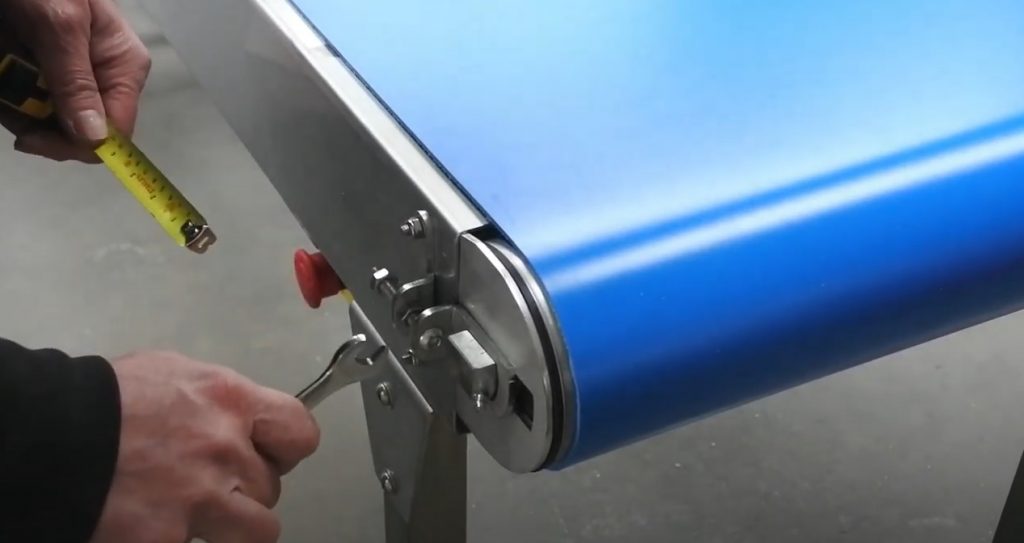

One of the most common conveyor belt maintenance issues is when the belt slips out of alignment and starts to drift off centre. The process of bringing the belt back to the central path is known as conveyor belt tracking.
As the process to track a conveyor belt is a relatively simple one, we've put together a quick additional guide to help you get your belt back on track.
Follow these simple steps:
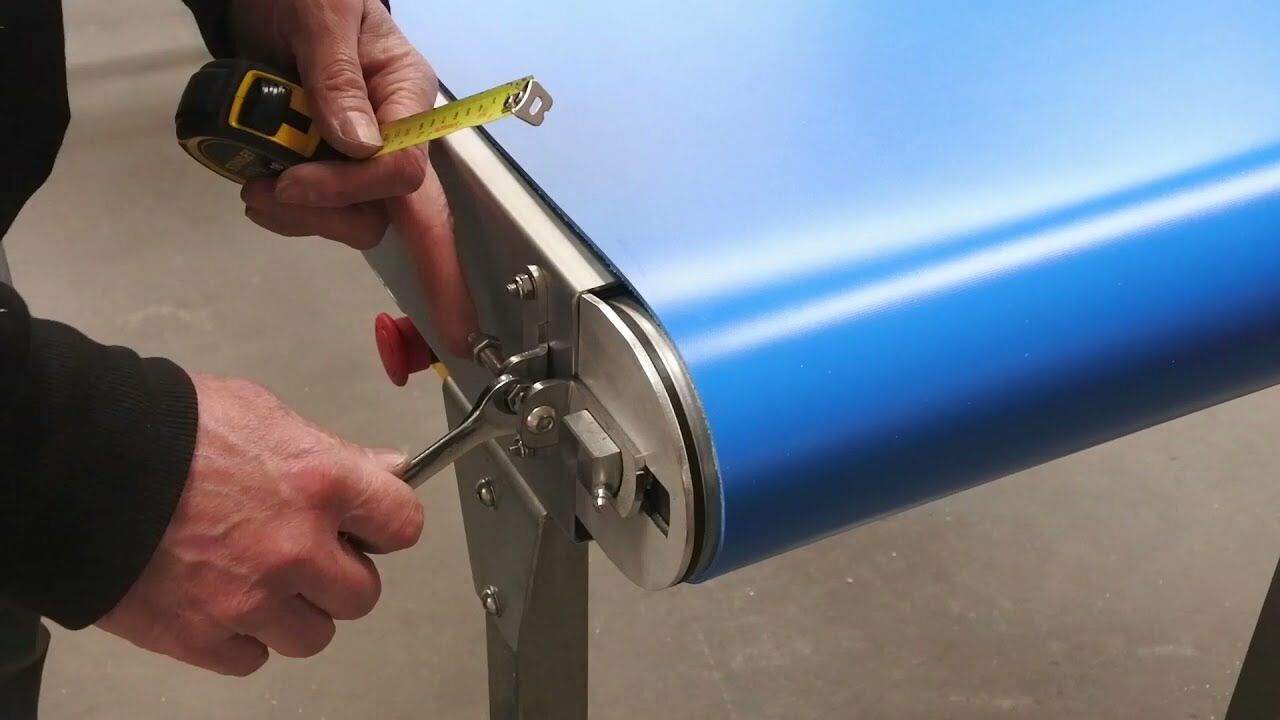
Belt conveyor tracking is the practice of keeping the conveyor belt travelling along the path as it is required. A conveyor belt should not drift off path as it would cause the conveyor to work incorrectly. When installing a new belt there can often be tracking issues, these require adjustments to counter any tracking problems to ensure the conveyor maintains optimal performance. It is best practice to do any belt tracking adjustments whilst the belt conveyor is running. A belt may also need additional tracking adjustments as it is worn in.
Before considering belt conveyor tracking methods it may be of use to give a brief overview of what a belt conveyor consists of. Each of these parts play a role in ensuring correct belt conveyor tracking.
The belt is the material on which the products are transported. They're available in numerous materials such as thermoplastics, metal, rubber, fabric and leather. A number of these are available with different weaves and coatings. The goal of conveyor tracking is to ensure this belt runs straight.

When referring to conveyor systems, pulleys are sometimes also known as drums.

The head pulley usually drives the conveyor. It is important for this pulley to have good traction, for this reason it is often lagged. Lagging is where the face of the pulley is coated with a material such as rubber or ceramic coating which increases traction. During conveyor maintenance the lagging should be checked to ensure it is still generating friction and hasn't become worn down.
Located at the opposite end of the belt to the head pulley. Often an idler pulley but can be driven in some cases. The tail pulley can take the role of the take-up pulley in shorter conveyor belts.
A snub pulley increases a drive pulley's traction by increasing the wrap angle.
A Drive Pulley has an external power source which rotates the pulley and thus drives the conveyor belt. They're often used as the head pulley, however centre drive conveyors are common.
An Idler pulley rotates freely and is driven by the belt only, it has no drive function of its own.
A bend pulley is used for changing the direction of the belt.
These are adjustable pulleys to allow for proper belt tensioning
At the most basic level a conveyor consists of two pulleys; a drive pulley, an idler pulley, and a belt that wraps around them. In many applications however a standard belt conveyor without any additional tracking measures would be insufficient. For example when loading items onto the belt, the belt can be shifted off centre, without tracking measures in place the belt would run off and become damaged.
Belt tracking measures ensure that this does not happen and any issues can be fixed before the conveyor becomes unusable . As well as saving in the cost of repeatedly buying replacement belts, correct belt conveyor tracking can decrease overall maintenance and downtime. A modular conveyor however does not have these tracking issues.

Conveyor belt tracking problems are often blamed on the belts themselves. This is not always the case. Usually the problems can be blamed on poor installation, such as pulleys and rollers not being properly adjusted, or using the wrong belt tracking measures. Sometimes however it's simply just faulty conveyor design.
Factors that can affect belt tracking include:

As a rule, the belt moves to the side of the pulley or idler that it first comes into contact with. If the pulley is slanted down on the left side, the belt will move to the left. If the pulley is slanted down on the right side, the belt will move to the right. A basic belt conveyor tracking adjustment involves gradually repositioning the pulleys to aid the belt in realigning. It takes several revolutions of the belt to see if the adjustment has been successful, therefore any adjustments should be carried out incrementally and slowly to avoid any drastic effects which could damage the belt.
Belt tracking measures can be quite basic, they're used to maintain a correctly aligned belt in position. In other cases however, additional measures may be required.
As mentioned above, usually a belt will follow a path moving towards the edge of the roller it meets first. In the case of a belt on a crowned pulley, it will travel towards the centre. Whichever side the belt is tracking to, due to the shape the central area is where the belt tension will be higher. As the belt grips onto the central area and the roller pulley continues to turn the belt is re-aligned centrally.
Once the belt reaches the centre however the tension should be even as there is an equal amount of slack on each side of the belt. If the belt begins to go off centre for any reason, the crowned pulley will naturally guide the belt back into the centre. The taper ideally should be very gradual, as you can imagine any angular parts the belt will run over could cause damage to the belt. When performing belt conveyor tracking, there should be enough tension in the conveyor for the belt to conform to the crown pulleys if used.
A guiding pulley, or control pulley, is a snub pulley that is adjustable. As previously mentioned a snub pulley increases the wrap angle of the belt over the drive pulley which improves the traction. These pulleys can be coated with a material to improve friction. Ideally the area of contact for the belt on the guiding pulley should be a minimum of 30 degrees of the pulley circumference.
A guiding profile is a shaped wedge that is added onto running side of the belt. Often V shaped, though other shapes are sometimes used. They are not recommended for general use as belt conveyor tracking assistance as they incur higher production costs and have a limited scope for use.
A guiding profile is not usually utilised for belts running at high speed as the guiding profiles have a tendency to slip from their running groove. They are suitable however to lessen the effects of transverse forces on the belt, such as occasions where side loading is required. In wider belts, or belts of thinner material it is recommended to use two guiding profiles, one located at each edge of the belt rather than one centrally.
Where a belt has a v-guide in the underside, often the pulley will be straight faced, as there is no need for the pulley to have a crowned shape, the guide alone should keep the belt centred as required.
As a short guide this should give you an idea of what could be causing your belt tracking issues, and how you can fix them. If you would like expert advice on your conveyor belt tracking, contact your conveyor manufacturer.
Spaceguard is a UK conveyor system manufacturer with many years of experience in providing high quality, cost effective automation and industrial equipment.
Every system is designed and manufactured to order in the UK. Tell us what you need and our team will help you spec it and send a fast, free quotation.

SpaceGuard were really pleasant and professional to deal with, and sent a detailed drawing and 3D render for approval before manufacture. The finished units are built exactly to this specification, with really good weld quality and paint finish.
Spaceguard were incredibly helpful and patient with us while we worked out the best bench solution for our space. The bench arrived on time, in good condition and it is exactly what we wanted.
We have found SpaceGuard to be knowledgeable, professional and helpful. The installations team were efficient and friendly. Thank you!
Spaceguard have been a pleasure to deal with. We have used them on a number of occasions for our pack station work benches which are ideal for our set up. I would definitely recommend them!
Spaceguard provided an excellent service for us, being prompt with the quotation and communication. They were happy to accommodate our design requirements and were incredibly flexible.
A very well made and strong unit. Impressive quality.
Good product quality, quick lead times and reasonable pricing. Very helpful in understanding and contributing to the specification of the solution.
Great professional service. Nothing was too much.
Please complete the form below to send a message to our team. For product and pricing enquiries please include a brief overview of your requirements.
Quick response guaranteed 8-5pm Mon to Thurs, and 9-3pm on Fridays

We use cookies
We use essential cookies to make this site work, and optional cookies to understand how it is used and to measure our advertising. Choose which optional cookies to allow. Privacy policy


